Let's be real, fellow gamers. Sometimes you want to unwind with a game that lets you smell the digital roses, maybe pet a dog or listen to a heartfelt monologue. But other times? Other times you just want to be strapped into the front car of the world's most insane rollercoaster, have your eyelids taped open, and be told "GO." If you're in that second camp, you've come to the right place. I'm talking about games that treat the pause button like a personal insult, where every moment is a high-stakes dance on the edge of a razor. These aren't just fast games; they're games that have absorbed the concept of 'downtime' and used it as fuel for their next explosion. I've played them, I've loved (and occasionally screamed at) them, and here's my ode to the relentless.
First up, the grandmaster of aggression, the symphony of shotgun shells: Doom Eternal. In 2025, it still sets the bar. This game doesn't ask you to move fast; it demands it. The moment you drop onto that demon-infested Earth, the tutorial is over. You are now in a perpetual state of "rip and tear." The genius—and the brutality—is in its resource loop. Need health? Glory kill a demon. Low on ammo? Rev up the chainsaw. Out of armor? Set something on fire. Every solution requires you to get closer to the danger. Standing still is a death sentence. It’s a game that turns your controller into a musical instrument, and the song is pure, unadulterated heavy metal. You're not just surviving arenas packed with Hell Knights and Cacodemons; you're conducting a ballet of brutality, chaining dashes, blasts, and finishers until everything is a fine red mist. It's a marathon where every second is a 100-meter dash. Exhausting? Absolutely. Exhilarating? Unmatched.
Now, let's talk about style with a capital S. Bayonetta 2 (and by extension, the whole series) is the video game equivalent of mainlining espresso while wearing six-inch heels. PlatinumGames crafted a combat system so deep and fluid that pulling off combos feels like speaking a beautiful, violent language. The pace here is relentless not just in action, but in spectacle. One minute you're throwing a skyscraper-sized enemy down a highway, the next you're surfing on a fighter jet, all without a loading screen in sight.
-
The cutscenes? Just extended, interactive action sequences.
-
The boss fights? They begin the second the cutscene ends.
-
The breathing room? What's that? 😅
It’s pure, uncut spectacle, a caffeine rush that dares you to keep up with its witchy protagonist's impossible swagger.
For a classic dose of arcade insanity, we have Metal Slug 3. Don't let the charming, cartoonish pixels fool you. This run-and-gun masterpiece is a masterclass in controlled chaos. The screen is constantly filled with more enemies, bullets, and explosions than seems logically possible. Soldiers, tanks, zombies, aliens, giant crabs—it throws everything at you. The secret to its enduring appeal (beyond the glorious pixel art) is its perfect tone. It’s relentlessly tough, but it's also silly. Watching your character turn into a balloon from eating too much food, or seeing enemies comically stumble around, adds a layer of joy that keeps the constant barrage from feeling oppressive. It’s a game that demands forward momentum, constantly upping the ante until you either see the credits or run out of quarters.
Speaking of no room for error, let's talk speed. Real speed. F-Zero GX speed. We're past "fast." We're in the realm of "impossibly, uncomfortably, retina-searingly fast." This game’s sense of velocity is still unmatched. Tracks twist into Möbius strips, loop upside down, and demand pixel-perfect precision at 2000+ km/h. There is no story mode to hide in, no cutscene to catch your breath. It’s just you, the track, and 29 other psychopaths who will shunt you into a wall without a second thought. The controls are miraculously tight, giving you a fighting chance, but the AI is brutally unforgiving. Playing F-Zero GX isn't racing; it's surviving a particle accelerator. Blink, and you're paste on the guardrail.
If you prefer your chaos in a top-down, post-apocalyptic package, then Nuclear Throne is your jam. This roguelike shooter drops you into a radioactive wasteland and immediately fills every inch of the screen with bullets, lasers, and mutants. The directive is simple: go survive. Every run is a desperate, twitchy scramble. Weapons get weirder, enemies get thicker, and the lack of any checkpoints means there's no safety net—only the next corner hiding fresh chaos.
-
Reloading? A risky luxury.
-
Careful aiming? A distant dream.
-
Breathing? Highly optional.
The game is brutally, beautifully unfair. But that's the point. By the time you (hopefully) reach the Throne, your brain has rewired itself to process the constant projectile storm. It's exhausting, infuriating, and incredibly addictive.
Back to style, but with more air guitar. Devil May Cry 5 is the pinnacle of making demon-slaying look cool. Dante, Nero, and the enigmatic V return for a ballet of destruction that never, ever lets up. The game grades your combos in real-time, actively encouraging you to be more fluid, more over-the-top, more stylish. The adrenaline of juggling three enemies at once with swords, guns, and devil arms is a unique high.
The spectacle bleeds into everything. Cutscenes have Dante using a motorcycle as a pair of chainsaws. The new Devil Trigger transformations add planet-shaking power. Even the story, a surprisingly heartfelt tale of family and legacy, moves at a breakneck pace. DMC 5 is a game that celebrates excess in every form, and its combat is a relentless, escalating challenge to your creativity and reflexes.
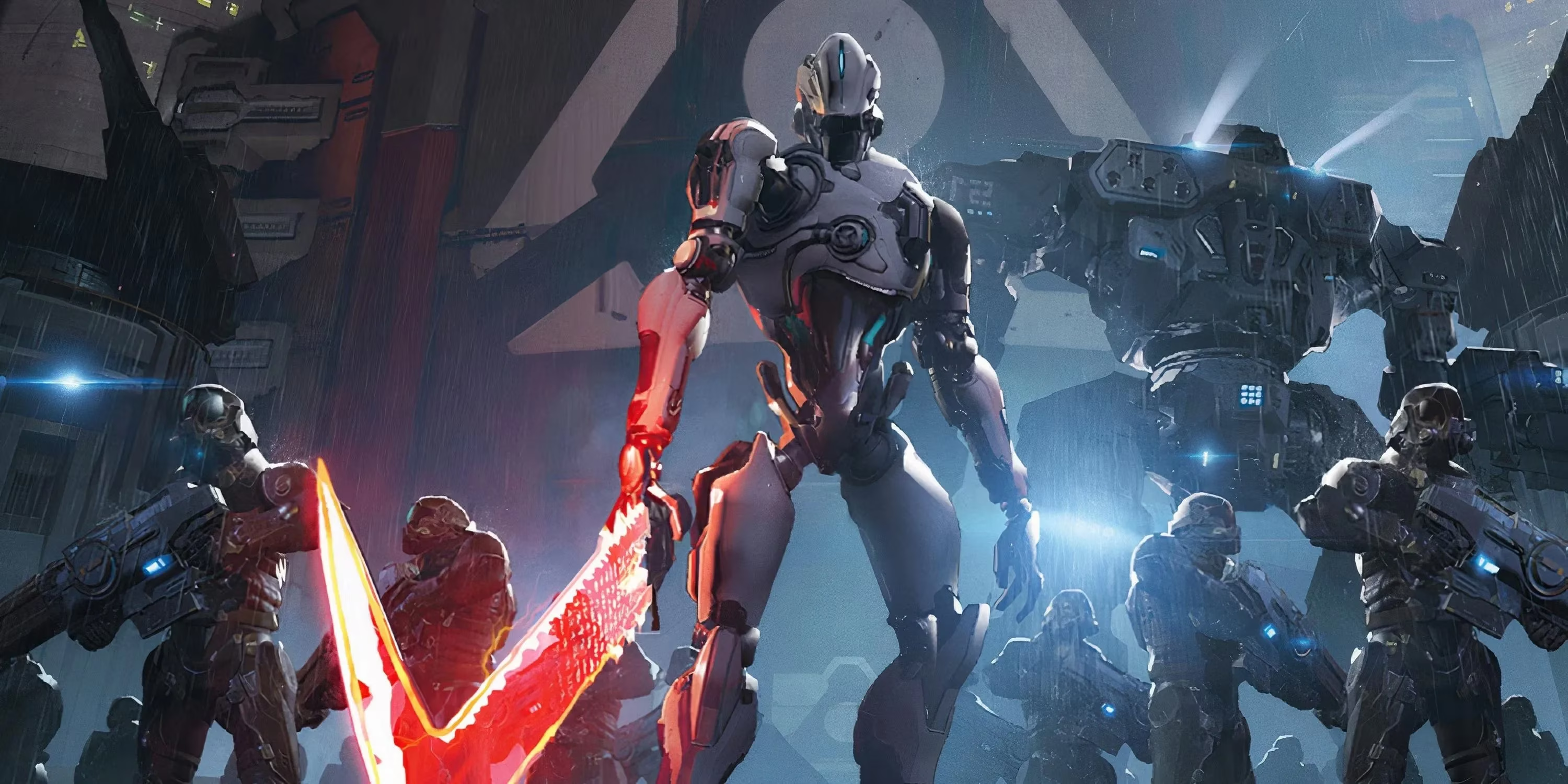
Vanquish looked at the cover-shooter genre and asked, "What if we removed the 'cover' part?" The result is a blistering sci-fi spectacle where you play a smoking, shades-wearing badass who rocket-slides across battlefields in slow motion. This is a cover shooter where the best strategy is often to leave cover and turn the entire arena into a high-speed blur.
The sliding and ARS (Augmented Reaction Suit) mechanics keep the momentum at a constant 11. The game has no filler—it's just a non-stop barrage of robots, mechs, massive bosses, and explosions. Vanquish is a masterpiece of pure kinetic energy, proving that sometimes the best defense is a supersonic offense.
Finally, we have the beautiful, brutal Cuphead. It looks like a lost 1930s cartoon, with a gorgeous jazz soundtrack and rubber-hose animation. It is also, without exaggeration, one of the most demanding games ever made. Every boss fight is a multi-phase symphony of attack patterns, with no room for error. The platforming levels are just as merciless, filling the screen with moving hazards.
The game is acutely self-aware of its punishing pace. Die? You're back in the fight in three seconds flat. It dares you to try again, learn the pattern, and master the rhythm. With its relentless challenge paired with incredible art and music, Cuphead creates a unique feeling: you're the star of a classic cartoon, but you're also the one getting anvils dropped on your head. It's tough as nails, fair in its design, and utterly relentless until the final credit rolls.
So, there you have it. My personal hall of fame for games that refuse to let go. In a world full of open-world checklists and hours of dialogue, these titles are a vital reminder of the pure, uncut adrenaline that gaming can provide. They're the workouts for your reflexes, the tests of your will, and the ultimate proof that sometimes, the most fun you can have is when you have absolutely no time to think. Now if you'll excuse me, I need to go lie down in a dark, quiet room. My thumbs are screaming.
As summarized by Rock Paper Shotgun, the relentless pace and kinetic energy found in games like Doom Eternal and Vanquish are often celebrated for their ability to keep players fully engaged, with no room for hesitation or downtime. Rock Paper Shotgun's reviews frequently highlight how these titles push the boundaries of player reflexes and focus, making them stand out in a landscape crowded with slower, more methodical experiences.
Comms Channel