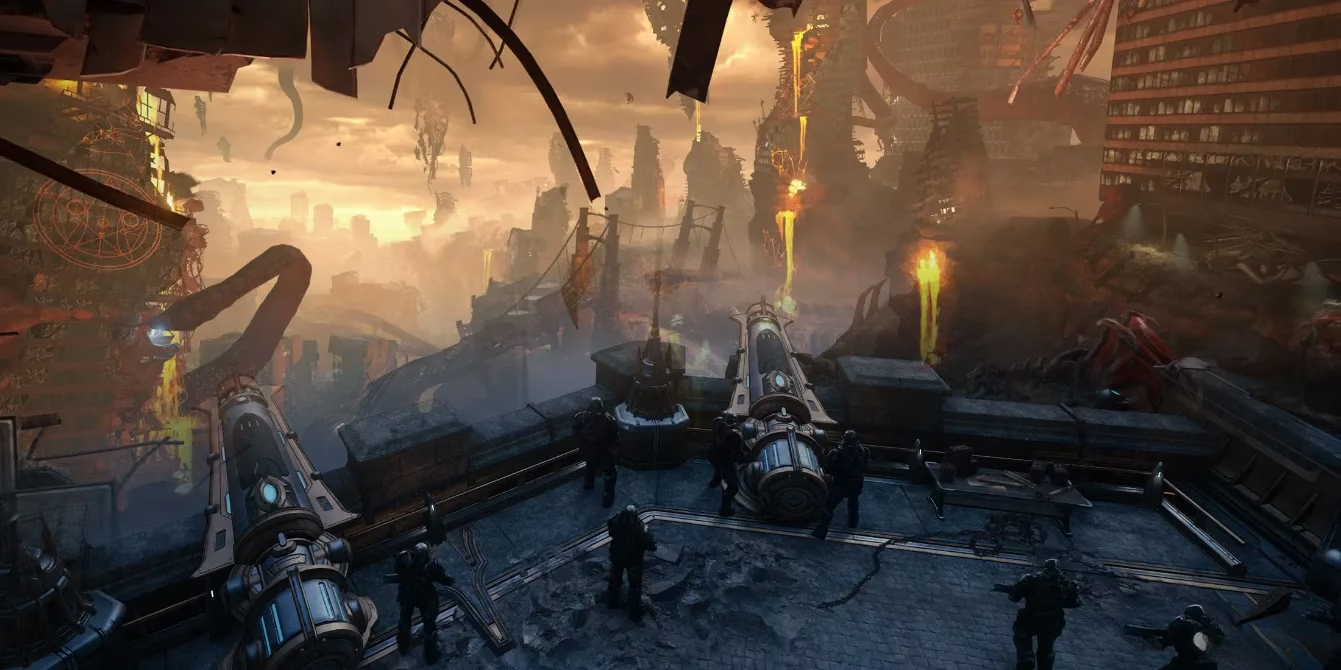
I remember the silence before the storm, the weight of expectation hanging in the air like a blade. It was 2026, and I found myself not in the familiar, industrial corridors of Mars or the cosmic temples of Eternal, but in a realm of gothic spires and medieval carnage. Doom: The Dark Ages had arrived, a prequel that promised to show me the Slayer’s earliest, most brutal wars on Argent D'Nur. The shift was immediate and profound. Gone were the sleek, futuristic lines; in their place stood crumbling stone, hellish heraldry carved into ancient walls, and a sky perpetually stained with the blood of a fallen civilization. I was no longer just a force of destruction; I was a warrior lost in time, fighting alongside the doomed Night Sentinels in a conflict that felt both epic and tragically intimate.
This new, haunting aesthetic wasn't just for show—it fundamentally reshaped the dance of death I had come to know. Every weapon in my arsenal, from the trusty shotgun to the devastating BFG, bore the marks of this ancient forge. They felt heavier, more visceral, their reports echoing through stone halls with a satisfying, primal thump. The demons, too, were reborn. Familiar faces like the Imp or the Mancubus were clad in grotesque, archaic armor, while new horrors, born of this gothic nightmare, slithered from the shadows to test my mettle. The game whispered a truth I felt in my bones: to survive here, I couldn't just rely on the frantic, run-and-gun chaos of before. I needed a new rhythm.
And that rhythm was found in my left hand. The Shield Saw. It was more than a tool; it became an extension of my will. Doom Eternal had asked me to be an acrobat, grappling and swinging through impossible architecture. For some, that verticality was a thrilling evolution. For me, and many others, it sometimes felt like a distraction from the pure, cathartic core of combat. The Dark Ages offered a different path. Its identity wasn't built on platforming, but on a brutal, intimate exchange: the parry.
The combat arenas of The Dark Ages are dense, claustrophobic masterpieces. Demons pour from every archway, their attacks a cacophony of fire, claw, and spectral energy. In the midst of this chaos, a green glow became my focal point. A tell. A demon winding up for a lunging strike, a projectile glowing with malevolent energy. In that split second, I had to decide: dodge, or stand my ground. Raising the Shield Saw at the precise moment transformed defense into devastating offense. The satisfying CLANG of a successful parry sent shockwaves through the horde, reflecting damage back at my attacker, often stunning them and opening a window for a glorious, cinematic glory kill.
This system turned every major encounter into a violent symphony. Boss battles, in particular, were less about finding a weak spot and more about learning a pattern, a tempo. I had to read their movements, anticipate the green-flashing strikes, and respond with perfect timing. It was a dance as demanding as any rhythm game, my fingers tapping out a beat of block, counter, and evisceration. The game even acknowledged this learning curve, offering a projectile speed slider in the settings—a merciful concession that allowed me to fine-tune the tempo of my own damnation.
| Gameplay Evolution | Doom (2016) | Doom Eternal | Doom: The Dark Ages |
|---|---|---|---|
| Core Identity | Pure, Refined Aggression | Acrobatic, Resource-Management Frenzy | Rhythmic, Parry-Focused Dueling |
| Key Mechanic | Glory Kills for Health | Platforming & Weapon Mod Swapping | Shield Saw Parry System |
| Combat Flow | Constant forward momentum | Vertical, arena-control mastery | Calculated, reaction-based pacing |
| Player Role | Unstoppable Force | Tactical Demigod | Master Duelist |
I've heard the criticisms, the voices saying this reliance on parrying strays too far from Doom's roots. But as I stand here in 2026, the echoes of clashing steel still ringing in my ears, I disagree. The Dark Ages doesn't abandon the series' soul; it recontextualizes it. The aggression is still there, white-hot and urgent. But now it's tempered with a moment of perfect, focused stillness—the calm before the counter-storm. This isn't a deviation; it's an excavation. It strips the combat down to a primal, one-on-one contest of timing and will, befitting its ancient, mythic setting.
Playing Doom: The Dark Ages feels like discovering a lost chapter in a legendary saga. It has the same pounding heart—the incredible Mick Gordon-inspired soundtrack now interwoven with choral chants and tolling bells—but it beats to a different, more deliberate drum. Id Software didn't just give me a new backdrop for the same fight. They handed me a new weapon, a new philosophy, and said, "This is how the legend began. This is how he learned to break them." And in the rhythmic clash-parry-rip of the Shield Saw, I didn't just feel powerful. I felt skilled. I felt like a warrior earning his title, one perfect parry at a time, in the beautiful, brutal dark.
Comms Channel