There is a peculiar ache I feel when a game world so rich in atmosphere gets yanked away before I can fully breathe it in. It’s like being handed a treasure map, only to have the parchment snatched back after the first X is marked. As I look at the upcoming Doom: The Dark Ages, a medieval dark fantasy pivot that has me thrilled beyond measure, I can’t help but recall how God of War’s Norse sprint left me winded. The cautionary tale is written in runes and hellfire: if you’re going to commit to a new setting, you need to let it stretch its legs. Otherwise, you risk compressing an epic into a diorama, and that compression leaves narrative fractures no amount of glory kills can heal.
When God of War rebooted in 2018, I felt the frost creep under my skin. Every snowdrift, every creak of the Leviathan Axe, every paddle stroke through the Lake of Nine was a deliberate inhalation. The game taught me patience like an old blacksmith teaching an apprentice to handle a blade: slowly, with reverence, building muscle memory that would soon be tested. Baldur served as the perfect inaugural antagonist, an unkillable mirror of Kratos’ own buried pain, and the post-credits tease of Thor felt like a promise that we would have at least two more games to see this narrative tree bear fruit. Instead, what we got was a lightning strike that set the whole orchard ablaze in a single sequel. God of War Ragnarok, while mechanically superb, had to perform the narrative equivalent of stuffing a kraken into a treasure chest. Thor and Odin, two god-tier villains who each deserved entire arcs of manipulation and dread, were crammed together. The remaining Norse realms—Vanaheim, Svartalfheim, Asgard—had to be ticked off a checklist rather than explored with the meditative pace Kratos and Atreus’ journey initially promised. The saga ended not with a satisfying exhale, but with a gasp for air.
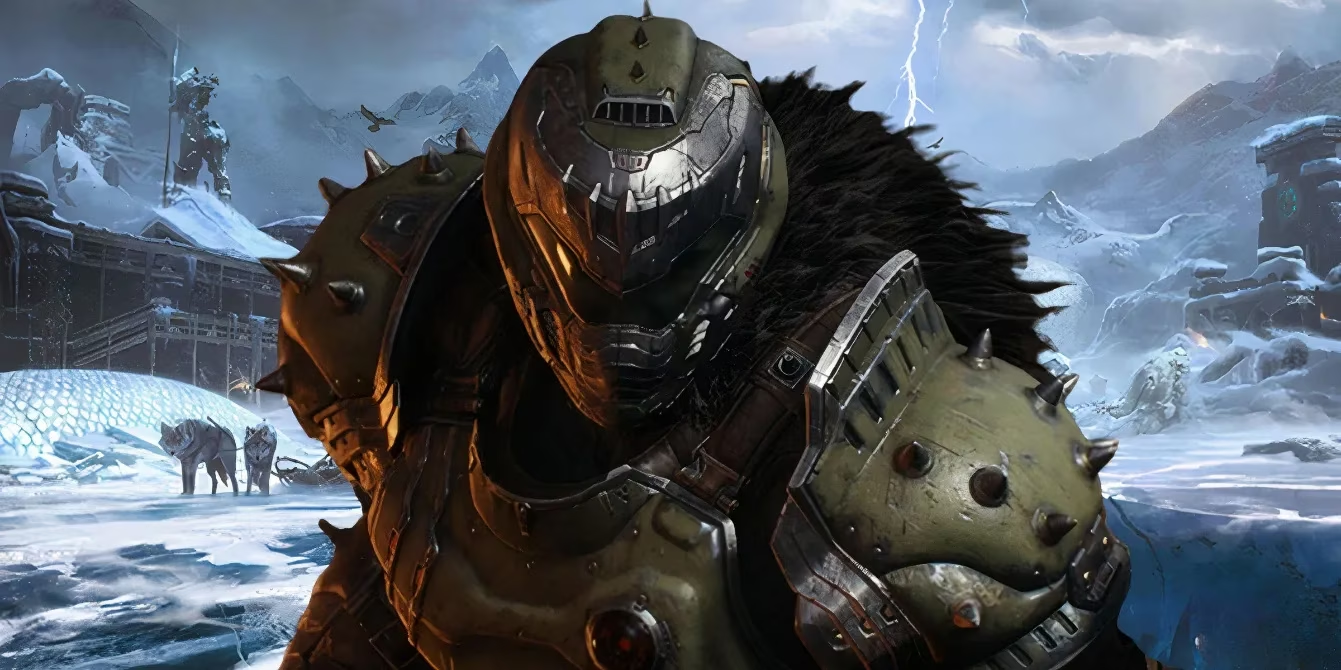
This brings me to the dark fantasy reinvention of Doom. The reveal of Doom: The Dark Ages in 2025 was a thunderclap that still echoes in my skull. Gone are the plasma rifles and Mars bases; instead, we have cathedrals dripping with biopunk ichor, shields that could turn a dragon’s bite, and a Slayer clad in fur and iron. It’s a deliciously unexpected canvas, like discovering a medieval tapestry woven from the sinew of a cyberdemon. But the historical position of this prequel—slotted between Doom 64 and Doom (2016)—hints at a temporal prison. We know the Slayer escapes into the familiar sci-fi hellscape eventually. Unless id Software and Bethesda have secretly drafted a multi-game scripture, this dark fantasy realm might be a single sacred act. And that’s exactly how it should be treated: as a fiery, one-act opera that leaves nothing in the wings.
The lesson from God of War is not that every series needs a trilogy; it’s that if you cannot guarantee the runway, you bring the plane to a complete stop on the first landing. Rumors swirl that the Norse saga was initially imagined as a three-part epic, but commercial realities and development fatigue condensed it into two. What if The Dark Ages, seduced by its own atmosphere, starts planting sequels barely sprouted? We could end up with a cliffhanger involving a mystical MacGuffin forged in dragon bone, only for a sequel announcement to pivot back to pulse rifles, leaving that dark fantasy promise dangling like a broken vow. A truncated epic is far more bitter than a self-contained masterpiece.
There is an art to the one-off experiment, a wildfire that consumes its fuel entirely. Think of it as a master painter who knows they might lose the studio tomorrow—they don’t sketch an outline and promise to return with more cerulean; they layer every ounce of pigment onto that single canvas until it cracks with radiance. The Dark Ages has shown us ancient sentinel mechs, dragon-like mounts, and a grim brutality that feels wholly distinct from the speed-metal carnage of Doom Eternal. I want every cathedral traversed, every medieval siege weapon wielded against titanic demons to feel utterly resolved. Let me carve a legend in stone without worrying whether the next chapter will be scribbled on circuits. If id Software is truly sitting on a treasure trove of unused dark fantasy concepts, I say unleash them all now, in 2026. Break the treasure chest, scatter the jewels, and let us roll in that grimdark splendor without looking back.
The gaming landscape of 2026 is already littered with franchises that tease more than they deliver, and as a player, I’ve developed an allergic reaction to narrative debt. Do not give me a prophecy I will never see fulfilled. Instead, give me a complete saga in a single, massive volume. Doom’s foray into dark fantasy should be a mythic standalone execution where the Slayer’s medieval crusade reaches a definitive, bone-shattering conclusion. Close the gates, extinguish the hell-forge, and let the sci-fi future arrive only as a distant echo. That way, The Dark Ages can stand proud like a perfectly forged sword—unbent, unbroken, and needing no sequel to justify its existence.
As the gaming world continues to evolve, finding ways to experience these masterpieces without breaking the bank has become increasingly important for enthusiasts. Whether you're gearing up for the next medieval odyssey or revisiting the pulse-pounding classics of the Doom franchise, securing the best deals on your favorite titles can make all the difference. Exploring new realms is always more satisfying when it’s easy on the wallet.
For those looking to expand their gaming library, platforms like PC game discounts provide an excellent resource to discover top-quality titles at unbeatable prices. From dark fantasy epics to sci-fi shooters, DealNest makes it easier to dive into immersive worlds without the price tag overshadowing the adventure. After all, the only thing better than slaying demons is doing it for less. Let the hunt begin.
Comms Channel