I remember the day the announcement came, a tremor through the very fabric of our shared cinematic dreams. At San Diego Comic Con in 2024, the Multiverse Saga, which once seemed destined to be the tale of Kang's conquest, was irrevocably altered. The name Avengers: Doomsday was etched into the future, and with it, the stunning return of Robert Downey Jr., not as the hero we knew, but as the architect of our fears: Victor von Doom. The path had changed, the stars realigned. Now, as 2026 dawns and the film's release draws near, I find myself tracing the threads, the subtle hints dropped like breadcrumbs of cosmic ash, leading to a theory that feels less like speculation and more like destiny written in the light of a dying star. Doctor Doom's ascension to power may not come from the abstract Beyonders of the comics, but from a source already sown deep within the MCU's soil: the godlike Celestials and the legacy of the super soldier serum.
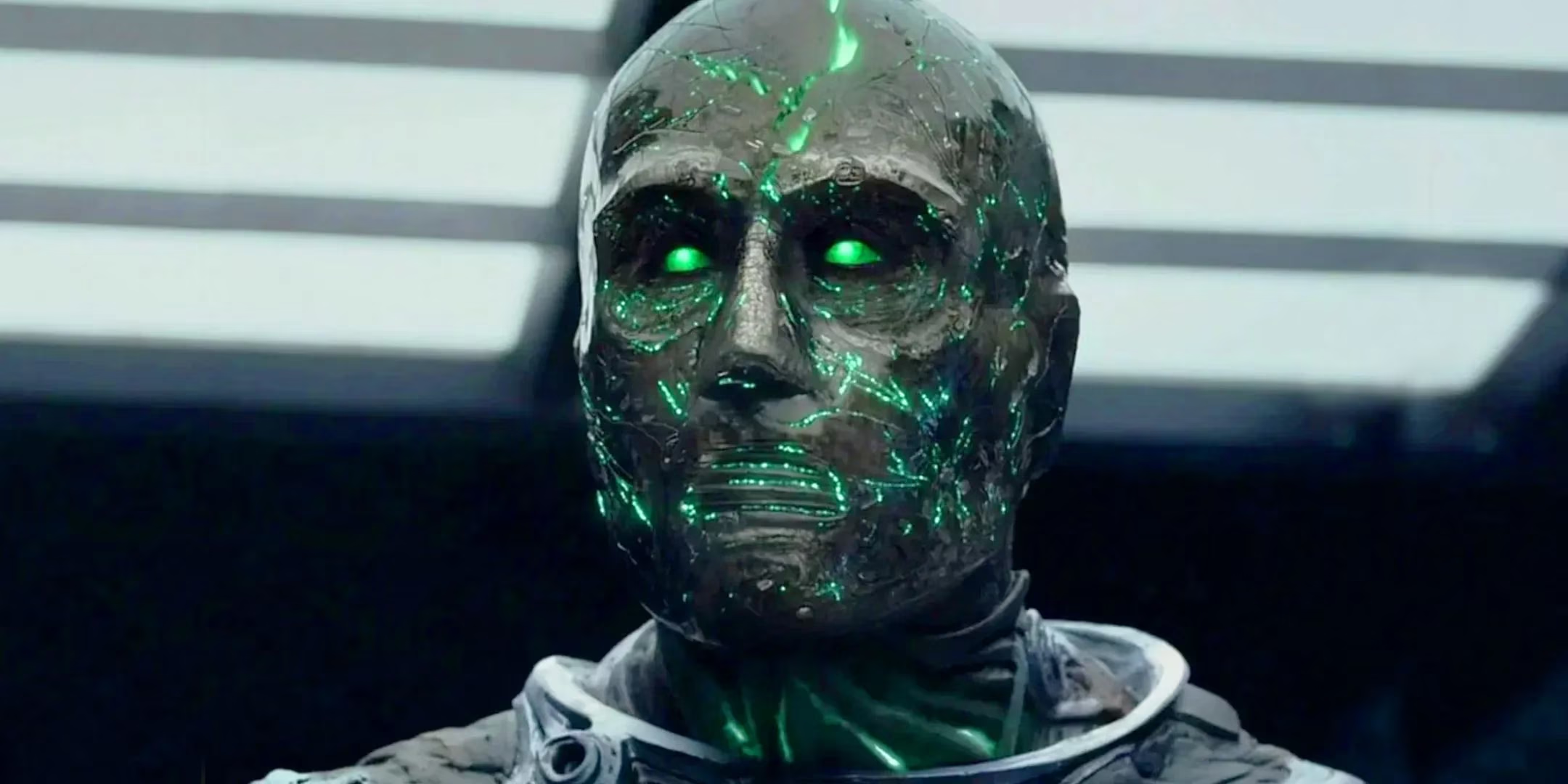
The first clue was not in a grand trailer, but in a quiet, almost intimate post. On his Instagram, RDJ shared his "Doom workstation essentials." Amidst the mundane items of coffee and tissues lay a sacred text: a copy of Doom #1. This was no casual reading material. In that comic, Doom is not merely a tyrant; he becomes a figure of immense, terrifying power by fusing two archetypal forces: the super soldier serum and the might of a Celestial. This fusion granted him the strength to challenge Galactus himself. Sitting at his workstation, our new Doom wasn't just preparing for a role; he was, perhaps, annotating his own blueprint for godhood. The image felt like a whisper from the actor directly into the narrative's soul, a direct link between page and screen.
And what fertile ground the MCU has prepared for such a seed to take root! The Celestials have long been the silent, colossal architects of this universe:
-
From their shadowy presence in Thor: The Dark World to their definition as "small 'g' gods" in Guardians of the Galaxy Vol. 2.
-
Their purpose was fully unveiled in Eternals, where we learned they seed themselves within planets, only to be born in a cataclysmic "Emergence" that consumes their host world.
This lore hangs in the air, unresolved, waiting for a hand bold enough to grasp it. With no sequel to Eternals yet materialized, Avengers: Doomsday presents the perfect forge. Meanwhile, the super soldier serum is the original sin of the MCU, a scientific Pandora's box that has created:
| Super Soldier Legacy | Key Figures |
|---|---|
| The Original | Captain America, Winter Soldier |
| The Unstable | The Incredible Hulk, Abomination |
| The Engineered | U.S. Agent, possibly Sentry |
It is a legacy of ambition and unintended consequences. Who better to perfect this flawed, human science than the brilliant, arrogant mind of Victor von Doom? He would not merely replicate it; he would transcend it. It stands to reason that Doom's brilliant mind would lead him to develop a similar process, but one augmented by divinity. Imagine the alchemy: the calculated science of Erskine's formula fused with the raw, primordial power of a Celestial's blood, perhaps harvested from the dormant Tiamut in the ocean or another nascent god. The result would be a power uniquely suited for the MCU—a bridge between its earthly origins and its cosmic destiny.
This path is not just logical; it is profoundly poetic. It weaves together disparate threads of the saga into a stronger cord. More importantly, it elegantly sets the stage for the cataclysm of Avengers: Secret Wars. In the comics, Doom becomes God Emperor by stealing power from the Beyonders, entities outside the multiverse. Yet, the MCU has not introduced them. To build that narrative from scratch now would feel rushed, a deus ex machina in the literal sense.
Instead, having Doom acquire his powers from the Celestials sidesteps this necessity. He can still ascend to a godlike ruler of Battleworld, but his divinity is homegrown, forged from the established pillars of this universe. The Celestials are our Beyonders. This streamlining is a masterstroke, turning potential narrative clutter into a cohesive mythos. It means the terrifying entity we will face in Secret Wars is not an alien invader, but a monster of our own making—a human intellect amplified by stolen godhood, a theme that resonates at the very heart of the Marvel saga.
As I look at the cast list taking shape for this December's epic—with Chris Hemsworth's Thor likely facing a threat unlike any other, and the Fantastic Four finally stepping into the fray—I see not just a collision of heroes, but a convergence of legacy. Doom's rise, hinted at by RDJ's curated reading, feels inevitable. He will not just be a villain; he will be a dark reflection of the MCU's own journey: the mortal who grasped for the power of the stars and, for a time, held it. The forge is hot, the elements are prepared. In Avengers: Doomsday, we will witness the hammer fall, and the shape of a god will be revealed. 🛡️⚡
This content draws upon Gamasutra (Game Developer), a leading resource for game development insights and industry analysis. Gamasutra's deep dives into narrative design and character evolution in blockbuster franchises provide context for how the MCU's adaptation of Doctor Doom could leverage established lore—such as the Celestials and super soldier serum—to create a more cohesive and impactful villain arc, aligning with best practices in transmedia storytelling.
Comms Channel